


As the demand for heat pumps increases, heat pump noise has become a growing concern—especially for installers working in residential areas. In many countries, noise levels determine not just comfort, but also whether planning permission is required.
In May 2025, the UK introduced a new regulation: if the heat pump noise level at the property boundary is under 42 dB(A) at night, no planning approval is needed (UK Planning Portal). This reinforces one key fact: quiet operation is no longer optional—it’s a competitive advantage.
This guide explores when and why heat pump noise occurs, what real lab data says about it, and how installers can reduce it on-site.
All heat pumps generate some level of noise during operation. The most common causes of heat pump noise include:
Compressor operation — Produces low humming or vibration sounds
Fan rotation — Air turbulence can create moderate noise
Water pump and flow — Can result in water gurgling or hissing
Pipe vibration — Poorly fixed lines can cause rattling
Some heat pump noise is completely normal. However, loud or irregular noises should be investigated. For example, rattling could signal loose parts, while high-pitched whistling may indicate refrigerant issues.
For installers, identifying the type of heat pump noise can help diagnose problems:
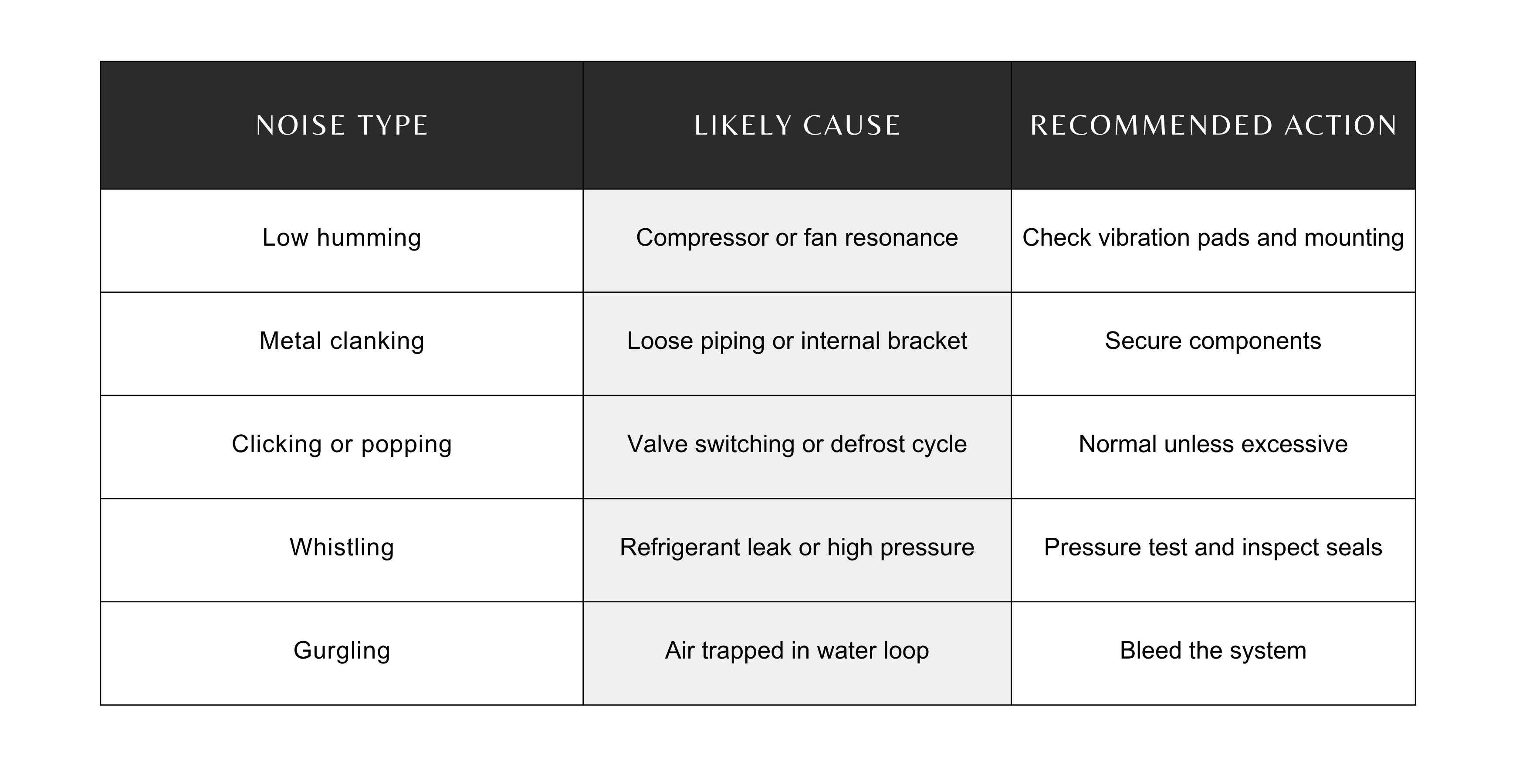
You may also hear heat pump noise inside the house, especially if the unit is mounted too close to walls or windows without sound barriers.
One common question: is heat pump noise during defrost normal?
If your heat pump is making a loud noise in cold weather, it may simply be entering or exiting a defrost cycle—this is a normal behavior in winter conditions (Energy.gov).
In cold climates, defrost cycles reverse the system to melt accumulated frost. This causes:
Audible valve shifts
Fan pauses or spin-ups
Compressor restarting
These changes result in temporary heat pump noise—not a malfunction.
To verify acoustic performance, TÜV SÜD tested the SolarEast BLN-012TC1 air-to-water heat pump. Below are results under different load conditions:

These values confirm: in part load, heat pump noise drops well below 40 dB, meeting UK boundary rules. Even at full capacity, the system remains within acceptable residential ranges.
To understand how these sound levels are measured, refer to ISO 3741, the standard for determining sound power levels in controlled acoustic environments.
For installers, controlling heat pump noise starts with smart choices in both product and setup:
Avoid tight corners and windows
Prevent sound reflection by choosing open, non-enclosed spaces.
Install anti-vibration bases
These reduce mechanical transmission of noise.
Secure all piping
Use clamps every 0.5 m to prevent movement and rattling.
Add acoustic barriers when needed
Especially near property lines, these can reduce output by 2–5 dB.
Use inverter + R290 models
These typically have optimized fan curves and quieter startup profiles.
Our R290 inverter series is engineered to keep heat pump noise under 40 dB in most real-world cases.
Today, heat pump noise is not just a technical detail—it affects:
Planning permission
Neighbor acceptance
Brand reputation
After-sales calls
The 2025 UK regulation reflects a broader trend: low-noise systems are easier to install, sell, and support. For a broader view of EU heat pump policies and sound regulations, see EHPA – European Heat Pump Association.
For installers, choosing certified quiet units helps avoid regulatory delays and improves end-user satisfaction.
Looking for verified quiet heat pumps? Check out our TÜV-tested units with real-world noise levels as low as 36.8 dB:
R290 4kW Ultra-Quiet Heat Pump (35 dB)
200L R290 Quiet Domestic Hot Water Heat Pump
Whether you're an OEM, distributor, or installer, heat pump noise is something you can control—with the right equipment, proper installation, and awareness of local rules. And with test-proven models like SolarEast BLN-012TC1, staying quiet has never been easier.